


Was Wes Huff a Fake the Entire Time?


Editor Note:
Christian apologist Wes Huff has now publicly admitted to plagiarism, confirming that the controversy surrounding his ministry was far more serious than a few careless citations or mistakes made during his college years. On November 19, 2026, Huff confessed, "I have plagiarized the work of others. This was wrong, and it was sinful." He also acknowledged that the problem extended much further into his work than he had previously admitted. For years, Huff built a reputation as a brilliant Christian apologist, impressing audiences with his apparent command of biblical history, ancient manuscripts, and theological scholarship. However, revelations that portions of his academic writing and public presentations were taken from other scholars without proper attribution have raised serious questions about the originality of his work. This was not simply a matter of forgetting to cite a source. By Huff's own admission, it was a recurring pattern of dishonesty, and it has understandably caused people to question just how much of his celebrated expertise was genuinely his own.
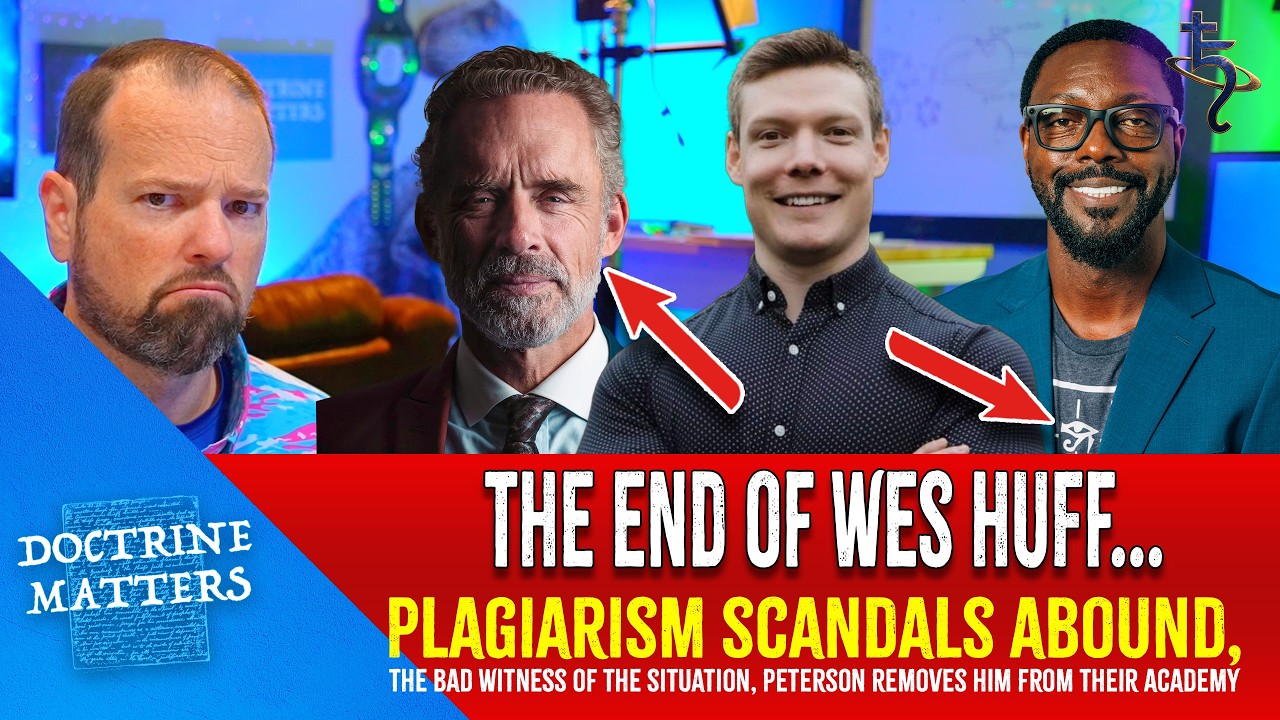
Perhaps the most astonishing aspect of this scandal is that even scholars who previously admired Huff's work have expressed disbelief at what has been uncovered. Biblical scholar William A. Ross, whose material Huff allegedly copied, explained that the content in question was not some groundbreaking academic discovery but a basic introductory article explaining material widely understood within his field. Ross revealed that he had previously met with fellow scholars to discuss how they might emulate Huff's successful approach to communicating biblical scholarship to the public, only to discover that Huff had allegedly plagiarized the work of several people at that very meeting. Peterson Academy, which initially defended Huff, subsequently removed his course after concluding that the plagiarism extended beyond an isolated incident from his younger years. This raises an uncomfortable but legitimate question: If a man presenting himself as an expert must borrow even elementary explanations of biblical scholarship from others, how deep is his own understanding of the subjects he teaches? Plagiarism does not automatically mean a person knows nothing, but when the copying becomes this extensive, the public has every reason to reconsider the credibility of the expert they thought they knew.

Update, November 19, 2026
On Thursday, November 19, 2026, Huff posted a new statement on X. He did not hedge. He said, "I have plagiarized the work of others. This was wrong, and it was sinful."
He said that over the years he allowed himself to develop justifications for what he had done, minimized how serious it was, and at times pushed it so far from his mind that he failed to reckon with it. "These patterns have affected far more of my work than I ever wanted to acknowledge," he wrote.
He also confessed that his first response was wrong. "I deeply regret my initial defensive and dishonest response to the accusations, and my involvement of others in that response."
He apologized to the people whose work he treated as his own, and to those who trusted him. He said he is stepping back from his ministry and church work, submitting to Apologetics Canada's review and to any academic discipline he will face, and placing himself under the care of his church and elders. "I know that repentance is more than words," he wrote, "and I recognize that it will need to be demonstrated through my actions going forward."
Christian Post reported that Apologetics Canada said the same day it is working with a third party consulting firm to oversee the review, and that it has hired an independent plagiarism expert to assess the work under review.
Church Leaders also reported that Peterson Academy removed Huff's course, "The Historical Reliability of the Bible," and that Midwestern Baptist Theological Seminary ended its advertising partnership with him. According to that report, Mikhaila Peterson said Huff contacted them early, told them the accusations were "very bad," and advised them to pull the course. The academy said it first stood by him, then changed course after concluding the plagiarism was not an isolated event from years ago.
Wes Huff is a Christian apologist out of Toronto who became widely known after appearing on Joe Rogan's show in 2025. Christian Post and The Blaze report that he serves as vice president of Apologetics Canada. For many Bible believing people, he has been a familiar voice on manuscripts, history, and the reliability of Scripture.
The concerns first burst into public view in early November 2026. The Blaze reported that on Sunday, November 8, American biblical scholar Dan McClellan posted a video alleging that Huff plagiarized significant parts of a 2016 paper. That paper, titled "Christological Claims: A Textual Consideration of John's Gospel," had been posted to Academia.edu while Huff was studying at Tyndale Seminary in Toronto. McClellan said it tracked an earlier paper by Brian J. Wright, senior pastor of Redeemer Community Church in Pensacola, Florida, in argument, wording, quotations, sources, and even citation errors. Huff did not cite Wright in the paper.
I want to be plain. I have not sat in a university hearing, and I am not going to pretend I can issue an official academic verdict. But this part of the story is no longer only an allegation. Huff has now admitted that he plagiarized the work of others, and he called it sin.
More claims followed. Professor Stephen C. Carlson said Huff had used his work without acknowledgment and called it "textbook plagiarism." Others pointed to additional student papers and to infographics on Huff's website. Protestia reported that one of those graphics appeared to use wording from other pages without quotation marks, while also warning readers not to jump to the worst conclusion, because Huff may not have designed every graphic himself.
Reports also said Huff's website and some of his YouTube videos were taken down for a time, then restored. Church Leaders reported that the website later came back online. His first response video was later deleted. Protestia saved a copy of it.
Then the conversation moved beyond old student papers. This week, people on X have been circulating a clip, highlighted in a video from the account Paulogia, and arguing that Huff read large portions of a book by Brent Nongbri while appearing to stumble and riff, as if the thoughts were coming off the top of his head. I have not independently verified that comparison. I am reporting what is being said in public, including posts I saved so I could look at them more carefully.
If those newer claims are true, they would not be about a messy paper from 2016. They would raise a harder question about whether the same habit followed him into the public teaching that made him famous. That is why some people are still asking whether this was going on the entire time. Huff has now admitted a pattern that affected far more of his work than he wanted to acknowledge. That still does not, by itself, prove every public claim about every talk. Asking the question is not the same thing as proving every answer.
Before that confession, Huff had already responded in public, and those earlier words still matter, because he later said they were defensive and dishonest.
In a YouTube video that has since been taken down, Huff took responsibility for what he called poor and problematic work. Protestia quoted him saying, "If you want to cancel Wes Huff from 2016 or maybe even 2017 and 2018, I do too. I was not a good writer. I was not a good academic." He said the papers he put on Academia.edu were bad, that their use of citation and attribution was "problematic" and "troublesome," and that there were people he should have referenced and credited whom he did not. He said he had used the site like a place to keep drafts and notes, and that some of the papers were unfinished and were never formally submitted. McClellan later rejected that explanation, saying the paper was published and had a cover sheet, a professor, and a submission date.
Huff also said he personally apologized to Brian Wright. Wright appeared in the video. Later, Wright told The Blaze, "As a scholar, I take academic integrity seriously and do not condone plagiarism. But as a Christian, I also believe in extending grace and forgiveness, recognizing that forgiveness does not excuse wrongdoing or eliminate accountability." Wright added that personal forgiveness does not remove the need for academic misconduct to be addressed separately.
On November 13, 2026, Huff posted this on X and said he was stepping back from further public comment while the Apologetics Canada board reviews the matter.
His family was also in the middle of a medical emergency. Huff asked for prayer after his young daughter was hospitalized with seizures. Christian Post and Church Leaders reported that she is 3 years old, and that she has since been recovering at home. That part of the story should not be used as a shield against honest questions, and it should not be treated as sport either. Pray for that little girl and for her parents.
Apologetics Canada said earlier that it was aware of the concerns, that its board is reviewing the matter carefully, and that it will share an update once the review is complete. As of November 19, 2026, that review is still underway, now with outside help, and there is still no final public report.
Some voices have already rushed to a hard conclusion. Others have rushed to defend him. Pastor Josh Howerton said he would not comment on the academic questions, but that people who know Huff describe him as a loving, good, and humble man of integrity. He also warned that some plagiarism accusations against conservative Christian teachers are brought by people with ulterior motives. That is one man's testimony about character. It does not settle the documents.
Another post I bookmarked put the matter in a more careful place. The account 5 Solas said the problem is not that everything Huff taught about manuscripts and history is therefore false. The problem, in that writer's view, is credit. Truth can still be truth even if a man failed to say where he got it.
WWUTT, which I also bookmarked, said two things can be true at once. They said Huff "has plagiarized and appears to have been dishonest about the extent of it," and they also warned that Dan McClellan is not a safe guide. McClellan is a Mormon scholar, and Huff himself said he did not know McClellan's motives but wondered about his agenda. None of that makes the documents disappear. It does mean we should not hand a Mormon critic the final word over a Christian teacher's life either.
WWUTT quoted a further claim that Huff was dropped by a would be doctoral supervisor amid plagiarism concerns this past summer. I have not independently confirmed that claim, and his November 19 statement did not address it. So I am leaving it where it belongs for now: as a public allegation, not as a proven fact.
So I come back to the question. Was Wes Huff a con man the entire time?
I am not going to answer that as if the jury already came back. What is public now is more than serious. Huff has admitted that he plagiarized the work of others, that it was sinful, that the pattern reached farther than he wanted to admit, and that his first response was defensive and dishonest. That matters. A man who tells the truth after first hiding it should be heard, and his repentance should be judged by what he does next, not only by a statement.
The harder question is still open. There are still public claims about talks and research presented as if they were his own, including the Nongbri comparison that I have not independently verified. There is still an unconfirmed claim about a doctoral supervisor. Those are not settled by a general confession, and they should not be treated as if they were.
Bible believing Christians should want the truth, not a team to cheer for. We can take Huff at his word on what he has now admitted. We can pray for his daughter and for genuine repentance. And we can wait for the review, and for a clearer word on the claims he has not yet answered.
Now that Wes is out of the way, can we talk about Sam Sey...
Prove all things; hold fast that which is good. (1 Thessalonians 5:21)
Recommended Reading
Want to go deeper? Get my book Empire of Error on Amazon. It deals with religious error, loyalty culture, and the habit of protecting a popular voice instead of telling the truth.
Sources
Jon Brown, Christian Post, November 14, 2026, Wes Huff addresses plagiarism allegations amid review.
Jesse T. Jackson, Church Leaders, November 13, 2026, Wesley Huff deletes plagiarism response video as accuser Dan McClellan speaks out.
Joseph MacKinnon, The Blaze, November 13, 2026, Pop theologian Wesley Huff briefly scrubs website, removes YouTube videos after plagiarism accusations.
Protestia, November 11, 2026, Apologist Wes Huff Accused of Plagiarism, Admits The citation use is troublesome.
Wes Huff, X post, November 13, 2026.
Wes Huff, X post, November 19, 2026.
Jon Brown, Christian Post, November 19, 2026, Wes Huff confesses to sin of plagiarism, asks for prayer.
Jesse T. Jackson, Church Leaders, November 19, 2026, Wesley Huff admits to plagiarism, calls it sinful, steps back from ministry.
Jesse T. Jackson, Church Leaders, November 19, 2026, Peterson Academy and Midwestern Seminary cut ties with Wesley Huff amid plagiarism allegations.
Bookmarked X posts: William, November 17, 2026; Matey, November 17, 2026; 5 Solas, November 18, 2026; WWUTT, November 15, 2026.


Comments